Google+ Cinema Viewfinder: Sam Rockwell
Showing posts with label Sam Rockwell. Show all posts

Thursday, October 11, 2012

The Other Side of Cinema: Argo (2012) and Seven Psychopaths

by Tony Dayoub


Argo does an outstanding job of establishing both its world and its central conceit in the movie's prologue. Intercutting between documentary footage and the type of comic book frames used in movie storyboards, director Ben Affleck establishes a key fact that will surprise younger viewers, the closeness of the U.S. and its one-time ally Iran in the years just before the dictatorial Shah was forced to flee the country during 1979's Islamic Revolution. Subsequent sequences depicting protesters overrunning the gates of the American embassy are evocative not only of the actual events they cover, but of the recent embassy protests in Benghazi, Libya where Ambassador Chris Stevens was assassinated. Much of what will no doubt fuel Argo's Oscar campaign—or its chances for Best Picture in the minds of Academy voters—is this prescience or timing.

Friday, May 7, 2010

Movie Review: Iron Man 2

by Tony Dayoub


Fulfilling the commercial objectives set by its preceding film, Iron Man 2 makes good on its aim to spearhead an entire Marvel Universe of film franchises. But at what cost? All of the goodwill engendered by its endearingly brash predecessor completely evaporates before this film reaches its denouement. Iron Man 2 doesn't play within any established dramatic constructs in existence. And it betrays the fine character work of its cast by limiting their appearances in order to tease fanboys with the promise of future entries in the tapestry it is intent on weaving.

Thursday, December 3, 2009

Movie Review: Everybody's Fine (2009)

by Tony Dayoub


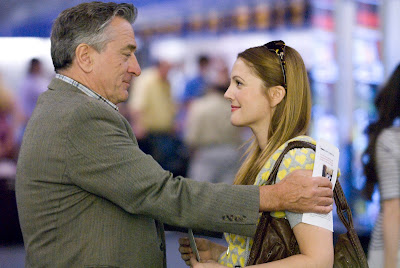
Robert De Niro is back. One could be forgiven for thinking his new film, Everybody's Fine, would be your standard issue Oscar-bait weeper from those Academy marketing mavens over at Miramax. And in many ways, the film is just that. But director Kirk Jones (Waking Ned Devine) surrounds Mr. De Niro with an interesting cast of younger actors: Drew Barrymore (Whip It), Kate Beckinsale (Underworld), and Sam Rockwell (Moon). The three (who usually headline their own movies) bring their A-game to what must have been a tempting proposition—the chance to work with a legend like De Niro. Except recently, De Niro has been trading on his reputation to star in some pretty ugly dreck in order to finance his business ventures, stuff like the career-killing Righteous Kill, in which he starred alongside another fading legend in even worse shape, Al Pacino. The good news is that Jones elicits a superb and subtle performance from De Niro (around which the whole film revolves), the likes of which we haven't seen since at least 1995 when he starred in Heat.


The story is a bit predictable, with De Niro's Frank Goode embarking on a journey to visit each of his four grown children after they all cancel their visit to see him for their first reunion since his wife died. Unable to find his son David in New York, he continues on to visit his three other children who live all over the country. Meanwhile, the siblings are all conspiring to keep him out of the loop concerning David, who reportedly suffered an overdose somewhere in Mexico. As they try to figure out what is going on with their youngest brother, they each obfuscate the issue by prodding Frank to go back home. Each of them lies about their personal life for fear that they won't measure up to the demanding Frank's expectations, high expectations which may have driven David to his careless lifestyle.

While their is plenty of opportunity for moments both lighthearted and sad as De Niro plays the cranky set-in-his-ways Frank, this is the first time in a while he stays a good distance away from the now all too predictable mugging that has marred his comedic work in movies like Meet the Parents. Instead, the actor plays Frank amazingly straight as a widower whose loneliness inspires him to reconnect with the children he never suspected had grown so far apart from him to begin with. While none of the young actors resemble each other in appearance or temperament (a typical problem in films of this variety), De Niro makes sure they all resemble him, complementing their performances so that he somehow manages to endow Frank with a distinct behavioral quality from each of his children. His Frank is driven like Beckinsale's Amy; befuddled and humble like Rockwell's Robert; and acerbically humorous like Barrymore's Rosie. He even manages to create an impression of David despite the character's absence, informing it with Frank's own ambitions which he projected onto his son.

Sometimes there are whimsical touches that enliven Everybody's Fine, like the way Jones has child actors stand in for each sibling whenever Frank first lays eyes on them. Other times those touches go a bit too far, as in a third-act dream sequence—where all of the inner turmoil is worked out between Frank and his kids—that is just a touch too on the nose in its frustratingly expository execution. But Jones never descends into maudlin sentimentality, always keeping the film moving briskly past its more melodramatic moments.

He has De Niro to thank for that also. Or maybe De Niro should be thanking Jones, since his performance is Oscar worthy. By directing the actor to internalize much of Frank's misgivings about his relationship with his kids, Jones encourages De Niro to modulate his later more overt emotional expressions like the actor one had always expected in earlier films. A disturbing encounter with a vagrant midway through Everybody's Fine and the inevitable physical toll it has on Frank even later in the movie are sequences which both triumph because De Niro has managed to withhold vital emotions from the viewer prior to the scenes, making their eventual release all the more touching and resonant. If for nothing else, De Niro's poignant performance is enough to recommend the movie.

Everybody's Fine opens in theaters tomorrow.

Wednesday, December 24, 2008

Movie Review: Frost/Nixon - Performances Sharpen after Transition from Stage to Screen

Strong performances continue to clutter up American cinema in 2008. Three strong contenders emerge from Ron Howard's latest film, Frost/Nixon. Written by Peter Morgan (The Queen), the movie is based on his play which debuted in London's West End. The original London cast returns, with Frank Langella (Superman Returns) in his Tony award-winning role as disgraced former president Richard Nixon, and Michael Sheen (The Queen) as famed TV host David Frost. The film depicts the behind-the-scenes events surrounding Nixon's 1977 television interview with Frost. In obtaining an interview with the former president, talk show host Frost saw an opportunity for fame and glory. The embattled Frost was losing ground in his fight to keep himself on the air in Australia and Britain after already having lost a broadcast in New York. This would be a chance to regain relevance in his industry. For Nixon, it would be an opportunity to rehabilitate his reputation after the Watergate debacle, submitting himself to an interviewer that in all likelihood would refrain from hard-hitting questions. Langella and Sheen prove to be evenly matched onscreen, even if their characters don't seem to be at first glance. Langella's Nixon is crafty, hiding a keen intellect underneath a deceptive mask of age and lumbering physical non-agility. Before one interview session, he innocently makes small talk with Frost. Just as the floor director counts down to camera rolling, Nixon slips in a question to Frost in order to unsettle him, "You have a pleasant evening last night? You do any fornicating?" But Sheen's Frost is not as overmatched as everybody thinks. After agreeing to avoid any questions on Watergate until their fourth session, he leads into their first conversation with the question, "Why didn't you burn the tapes?" Though only slightly ruffling Nixon's feathers with his impatience, the incident seems to encapsulate Frost's showmanship. This quality is later demonstrated to be invaluable in preserving the attention focused on the interviews, as he deals with criticism from the journalistic establishment for his lack of credibility, and wrestles with raising financing for the endeavor. Yet despite the larger than life characters that front the film, its emotional heart is Sam Rockwell's interpretation of James Reston. One of Frost's researchers, it is Reston who seems to inspire Frost to reach beyond just the banal anecdotes that, as Reston puts it, would fascinate a "talk show host." Reston believes it is their job to give Nixon the "trial he never had." Rockwell (Choke) is explosive in this small role which essentially serves as Frost's conscience, and I predict an Oscar nomination in his near future. The most surprising achievement director Ron Howard (A Beautiful Mind) accomplishes is staying out of the way of his actors. Instead, he focuses on broadening the play to cinematic scale. Some of it doesn't work, like an annoying framing device where some of the peripheral players in the drama relate the story from the future. In this case, I'm unaware if this was a device used in the play, but it seems to be a pretentious attempt to inject a false historical grandeur to the proceedings. Some of it does, like shooting at expansive locations in California and curiously, tightening the frame with frequent closeups, revealing nuance that would be difficult to see onstage. Perhaps it is Howard's own experience as an actor that serves him best in this film, trusting his cast to act the heck out of their parts. Frost/Nixon is easy to recommend. It transcends its stage roots to become a quite gripping example of the power of performance, and how filmmaking can hone it to an even sharper degree than the theater can. Frost/Nixon is in limited release.