 |
| Clockwise from top: Stephen Lang (as David Abrams), Anthony Denison (as Ray Luca), Darlanne Fluegel (as Julie Torello), Dennis Farina (as Lt. Mike Torello) |

Tuesday, November 15, 2011
The Chicago Way: Crime Story back on DVD for its 25th Anniversary
by Tony Dayoub
On September 18, 1986, director Michael Mann (Heat) made good on his promising career in TV and film with the debut of his new period cops-and-robbers saga, Crime Story. Not only did Crime Story’s feature-quality production design live up to that of its TV antecedent, Mann’s stylish Miami Vice; Crime Story also fulfilled its aim to present a morally complex world in which it was often difficult to tell those who broke the law from those who upheld it. Set in 1963, the show explores the multiple facets of a young hood’s rise to power in the Chicago Mob through the viewpoints of its three protagonists. Ray Luca (Anthony Denison) is the pompadoured criminal quickly ascending the ranks of the “Outfit.” Lieutenant Mike Torello (Dennis Farina) is the cop in charge of Chicago’s Major Crime Unit (or MCU) who bends the law in the service of justice. And David Abrams (Stephen Lang) is the idealistic young lawyer caught between the two men and their obsessive cat-and-mouse game. Today, a little over 25 years since its premiere, Crime Story: The Complete Series (Image Entertainment) comes out on DVD. At press time, review copies were not made available, so it’s impossible to ascertain if any improvements have been made over the questionable video quality of previous iterations. But this short-lived series, an influential precursor to the well-written serials littered throughout cable this decade (i.e., The Sopranos, Mad Men, Justified, and others), is worth owning despite any potential issues with its digital transfer.
Wednesday, November 9, 2011
UPDATED: Blue Velvet 25th Anniversary Blu-ray Giveaway
by Tony Dayoub

One of my all-time favorite films, Blue Velvet, is now available for the first time ever on Blu-ray. A week from today, I should have a review up at my other outlet, Nomad Editions: Wide Screen, where I'll focus on the 50 minutes of lost footage that appears on the disc as a bonus feature.
To celebrate this release, I am happy to give away a free copy of the new 25th Anniversary Blu-ray (courtesy of Twentieth Century Fox Home Entertainment and Metro-Goldwyn-Mayer Studios, Inc.) to each of the first FIVE people who can correctly answer a question related to the bonus footage (hint: if you go back through some of my recent tweets you can easily find the answer). But first, the rules:
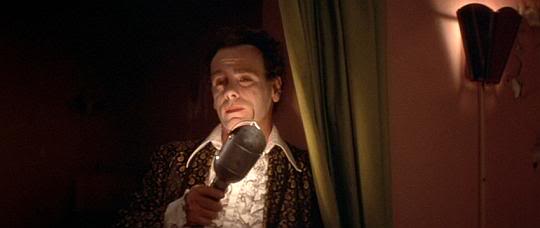
One of my all-time favorite films, Blue Velvet, is now available for the first time ever on Blu-ray. A week from today, I should have a review up at my other outlet, Nomad Editions: Wide Screen, where I'll focus on the 50 minutes of lost footage that appears on the disc as a bonus feature.
To celebrate this release, I am happy to give away a free copy of the new 25th Anniversary Blu-ray (courtesy of Twentieth Century Fox Home Entertainment and Metro-Goldwyn-Mayer Studios, Inc.) to each of the first FIVE people who can correctly answer a question related to the bonus footage (hint: if you go back through some of my recent tweets you can easily find the answer). But first, the rules:


Saturday, November 5, 2011
RIP Cynthia Myers
by Tony Dayoub
“Russ had contacted Playboy’s publicity department in Chicago, specifically asking for Cynthia Myers. But even though he and Hef were old friends, the magazine didn’t seem to make an effort to put us in touch, or it just slipped off someone's desk. I’ve been told that I’m the prototype of a Russ Meyer girl. When we met, I said, ‘I guess I’m your kind of girl, huh?’ And he just gave out a big belly laugh and said, ‘I’m glad to finally meet you. Cynthia Myers--that’s a pretty good last name, isn’t it?’"
- Cynthia Myers, December 1968 Playmate of the Month, on her first meeting with the director who would immortalize her in Beyond the Valley of the Dolls (1970)
 |
| Click for the uncensored version |
“Russ had contacted Playboy’s publicity department in Chicago, specifically asking for Cynthia Myers. But even though he and Hef were old friends, the magazine didn’t seem to make an effort to put us in touch, or it just slipped off someone's desk. I’ve been told that I’m the prototype of a Russ Meyer girl. When we met, I said, ‘I guess I’m your kind of girl, huh?’ And he just gave out a big belly laugh and said, ‘I’m glad to finally meet you. Cynthia Myers--that’s a pretty good last name, isn’t it?’"
- Cynthia Myers, December 1968 Playmate of the Month, on her first meeting with the director who would immortalize her in Beyond the Valley of the Dolls (1970)
Thursday, November 3, 2011
Cap and his Howling Commandos
Ensemble support in Captain America: The First Avenger
by Tony Dayoub

One of the most unexpected pleasures of some of the recent crop of superhero blockbusters is how adjustments to period and setting have freshened up what was fast becoming a moribund subgenre. Nearly half of Thor takes place in the mythological Norse realm of Asgard. X-Men: First Class isn’t just set in the 1960s; it takes place in a jet-set imaginary ’60s right out of the 007 films. The backdrop for Joe Johnston’s Captain America: The First Avenger, the most recent of these films to come out on Blu-ray and DVD, is an art-deco-by-way-of-steampunk version of the ’40s not seen onscreen since Johnston’s last superhero film, The Rocketeer (1991). Such application of period and locale legitimizes what for many is an inherently childish class of film. (Personally, I prefer to think of superhero films as escapist but, nonetheless, my kneejerk stance when discussing one is to come out of the gate defending it.) This affords the filmmakers the ability to attract a higher caliber of actors or technicians while generally making it a tougher sell to general audiences. (2005’s noir-ish Sin City, based on a graphic novel series, comes to mind.) What it also does, though, is allow the knowledgeable helmer (such as journeyman Johnston) to have some fun with cinematic conventions, and not just the comic book in-jokes that have become de rigueur in these films.
Subscribe to:
Posts (Atom)
